
Tonsils vs Adenoids: What Parents Should Know
Parents tend to say tonsils and adenoids in the same breath. They sit in different places and cause different problems, which is why one child keeps getting sore throats while another mainly snores and breathes through the mouth.
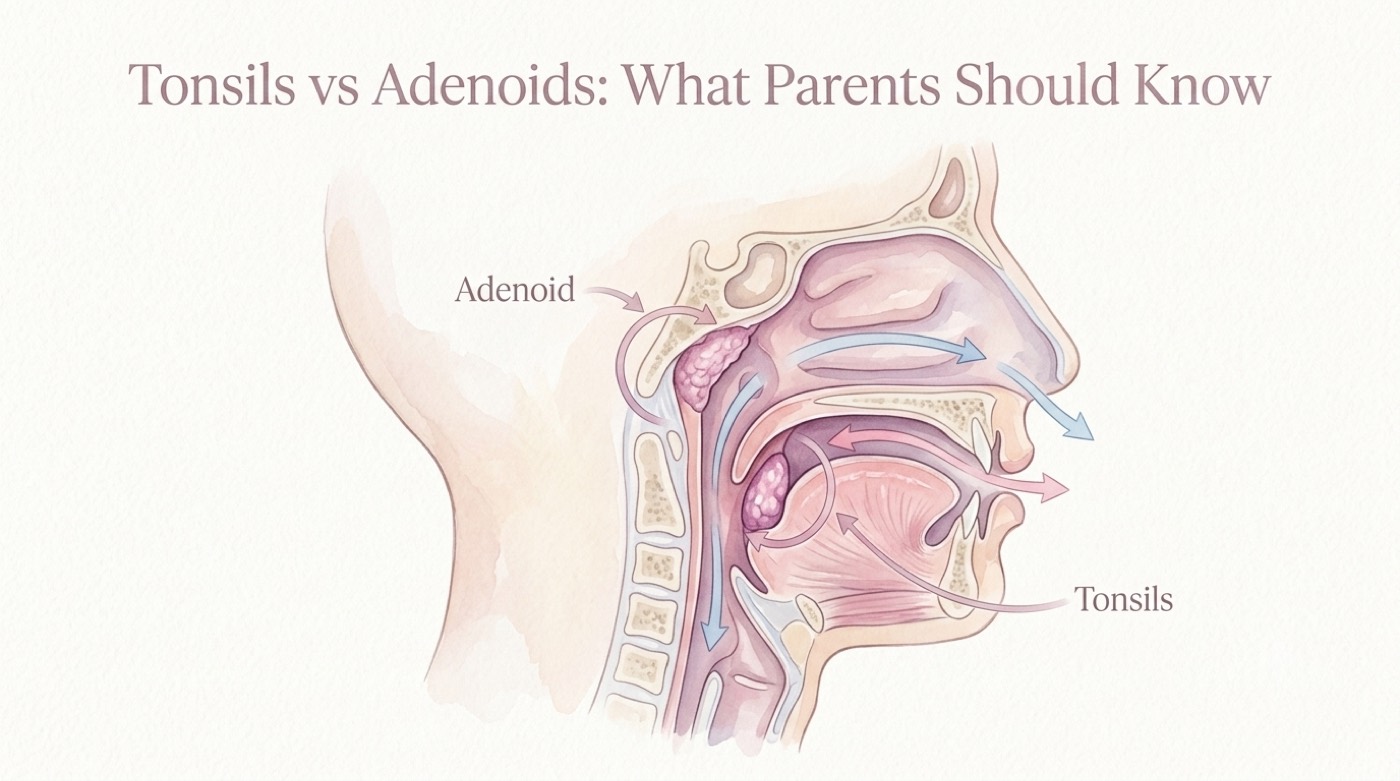
Tonsils and adenoids are both immune tissues commonly involved in children’s ENT problems, but they are in different places and cause different symptom patterns. Tonsils are visible at the back of the throat and commonly cause recurrent sore throat, fever, painful swallowing or enlarged tonsils. Adenoids sit higher up behind the nose and are not visible by simply looking into the mouth. Enlarged adenoids more often cause mouth breathing, snoring, nasal blockage, nasal speech, recurrent colds or ear problems. Some children have both.
Parents often use the words tonsils and adenoids together, and that is understandable. Both are common in childhood ENT visits, both can enlarge during infections, and both can contribute to disturbed sleep or repeated illness.
But tonsils and adenoids are not the same. Knowing the difference helps parents understand why one child may keep getting throat infections while another mainly has mouth breathing, snoring or blocked nose.
What Are Tonsils?
Tonsils are two oval-shaped pads of tissue seen on either side at the back of the throat. When a child opens the mouth widely and says aaah, the tonsils may be visible.
Tonsils are part of the immune system. In childhood, they help the body recognise germs entering through the mouth and throat. It is normal for tonsils to be larger in some children than others.
Tonsils become a problem when they are repeatedly infected, very enlarged, or contributing to breathing difficulty during sleep.
Common Tonsil Symptoms in Children
- Repeated sore throat or tonsillitis
- Fever with throat pain
- Pain while swallowing
- Bad breath during infection
- White patches or pus on the tonsils during acute infection
- Large tonsils touching or nearly touching in the middle
- Snoring or disturbed sleep when tonsils are very large
- Reduced food intake during painful episodes
Not every large tonsil needs treatment. The important question is whether the child is having repeated infections, significant sleep symptoms, breathing issues, or poor quality of life because of the tonsils.
What Are Adenoids?
Adenoids are also immune tissue, but they are located higher up, behind the nose and above the roof of the mouth. Unlike tonsils, adenoids usually cannot be seen by looking inside the mouth.
Because adenoids sit behind the nose, enlarged adenoids mainly affect nasal breathing, sleep and sometimes ear function. Parents may not realise the adenoids are enlarged until the child has long-standing mouth breathing or snoring.
Adenoids are more prominent in young children and often shrink as children grow older. However, in some children they remain enlarged enough to cause symptoms.
Common Adenoid Symptoms in Children
- Mouth breathing, especially during sleep
- Snoring or noisy breathing at night
- Blocked nose without much visible discharge
- Nasal-sounding speech
- Frequent colds or persistent nasal symptoms
- Restless sleep or disturbed sleep
- Ear fullness, recurrent ear infections or hearing concerns
- Open-mouth posture during the day
Adenoid symptoms are often mistaken for just allergy or frequent cold. Allergy can coexist, but persistent mouth breathing and snoring in a child deserve proper evaluation.
Tonsils vs Adenoids: Quick Comparison
| Feature | Tonsils | Adenoids |
|---|---|---|
| Location | Back of the throat, visible through the mouth | Behind the nose, not usually visible through the mouth |
| Main symptoms | Sore throat, fever, painful swallowing, recurrent tonsillitis | Mouth breathing, snoring, blocked nose, nasal speech |
| Sleep effect | Large tonsils can narrow the throat airway | Large adenoids can block nasal airflow and worsen snoring |
| Ear connection | Less direct, but may coexist with adenoid problems | Can contribute to Eustachian tube problems, glue ear or recurrent ear infections |
| Evaluation | Throat examination, history of infections and sleep symptoms | Nasal examination, nasal endoscopy or X-ray when needed |
| Surgery name | Tonsillectomy | Adenoidectomy |
How Parents Can Tell Which One May Be the Problem
If the main issue is repeated throat pain with fever, painful swallowing and visible tonsil swelling, the tonsils may be involved.
If the main issue is mouth breathing, snoring, blocked nose, nasal speech or disturbed sleep, enlarged adenoids may be contributing.
If the child has both recurrent throat infections and sleep symptoms, both tonsils and adenoids may need to be assessed together.
When Snoring in Children Should Not Be Ignored
Occasional snoring during a cold is common. Persistent snoring, however, is different.
Have your child assessed if you notice any of the following
- Snoring most nights
- Mouth breathing during sleep
- Restless sleep or frequent waking
- Pauses in breathing or gasping
- Daytime tiredness or irritability
- Bed-wetting after previous control
- Poor attention or school performance concerns
- Poor weight gain or growth concerns
Large tonsils and adenoids are common contributors to sleep-disordered breathing in children. An ENT evaluation helps assess whether the airway is narrowed and whether further sleep assessment or treatment is needed.
Can Tonsils and Adenoids Affect the Ears?
Adenoids are close to the opening of the Eustachian tube, which helps ventilate the middle ear. When adenoids are enlarged or repeatedly inflamed, they may contribute to ear pressure problems, recurrent ear infections or fluid behind the ear drum in some children.
This may show up as reduced hearing, inattentiveness, asking for the TV volume to be increased, delayed speech concerns or recurrent ear pain. If ear symptoms are present along with mouth breathing or snoring, the adenoids should be considered.
Does Every Child with Large Tonsils or Adenoids Need Surgery?
No. Many children with large tonsils or adenoids do not need surgery. Treatment depends on the child’s symptoms, frequency and severity of infections, sleep quality, breathing, hearing, growth and impact on daily life.
Surgery may be discussed when symptoms are significant or recurrent, especially when medical treatment and observation are not enough.
When Is Tonsillectomy Considered?
Tonsillectomy means removal of the tonsils. It may be considered in children with frequent, well-documented tonsil infections or when enlarged tonsils are contributing to sleep-disordered breathing.
ENT guidelines commonly consider the pattern, severity and documentation of infections. Parents should keep a record of episodes, fever, throat findings, antibiotics used, school absence and whether a doctor diagnosed tonsillitis.
When Is Adenoidectomy Considered?
Adenoidectomy means removal of the adenoids. It may be considered when enlarged or chronically infected adenoids are causing significant symptoms such as persistent mouth breathing, snoring, nasal obstruction, recurrent adenoiditis, recurrent ear infections or fluid behind the ear drum.
Sometimes adenoidectomy is done along with tonsillectomy. Sometimes it is done with ear tube or grommet surgery if middle-ear fluid is a major concern. The decision depends on the child’s symptoms and examination findings.
What Happens During an ENT Evaluation?
An ENT evaluation usually includes a detailed history and examination of the throat, nose and ears. Your doctor may ask about sore throat episodes, fever, snoring, mouth breathing, sleep quality, school absence, hearing concerns and previous medication use.
For adenoids, direct visualisation may require nasal endoscopy using a thin camera, or imaging in selected cases. If sleep-disordered breathing is suspected, further assessment may be advised depending on the severity and the child’s overall health.
What Parents Can Do Before the Appointment
- Note how often throat infections occur and whether fever is present
- Record snoring, mouth breathing or pauses in breathing during sleep
- Bring previous prescriptions and throat swab reports if available
- Mention school absence, poor sleep, daytime tiredness or eating difficulty
- Mention hearing concerns, ear pain or recurrent ear infections
- Avoid repeated antibiotics unless prescribed after proper assessment
ENT Consultation in T. Nagar, Chennai
Tonsil and adenoid problems are common in children, but the treatment decision should be individualised. Some children need observation and medical management. Some need evaluation for allergy, nasal obstruction or ear problems. A smaller group may benefit from surgery when symptoms are significant.
Dr Urvashi Singh evaluates children with recurrent tonsillitis, enlarged tonsils, mouth breathing, snoring, adenoid hypertrophy, recurrent ear infections and related paediatric ENT concerns in T. Nagar, Chennai.
Book an appointment for paediatric ENT evaluation in T. Nagar, Chennai.
Related Reading
Frequently asked questions
What is the main difference between tonsils and adenoids?
Can my child have both enlarged tonsils and enlarged adenoids?
Can enlarged adenoids cause hearing problems?
Do large tonsils always need removal?
When should parents see an ENT doctor?
Book your appointment today.
Visit Dr Urvashi Singh in T. Nagar, Chennai for ENT care for adults and children. The clinic team responds on WhatsApp within a few hours.